



AI-Assisted Content · SEO · GEO · Content Operations · Workflow Design
Building an AI-assisted content tool for 45 schools
What started as a content bottleneck became a tool.
- AI-Assisted Content
- SEO
- GEO
- Content Operations
- Workflow Design
The problem
Premier Early Childhood Education runs 45+ schools across the US, each operating under one of four distinct curriculum philosophies: play-based, faith-based, Reggio, and Montessori. Every school needed blog content that was SEO-optimized, curriculum-specific, locally relevant, and consistent with its brand voice.
With a team of three, creating that content manually was unsustainable. Each blog post required understanding the specific curriculum, pulling school-specific keywords, writing to the right parent persona, formatting for SEO, and then deploying through WordPress. The full cycle — writing, editing, design, captions, and publishing — took over a week per school per post. At 45 schools, that math doesn't work.
The approach
Rather than hire more writers, I built the system.
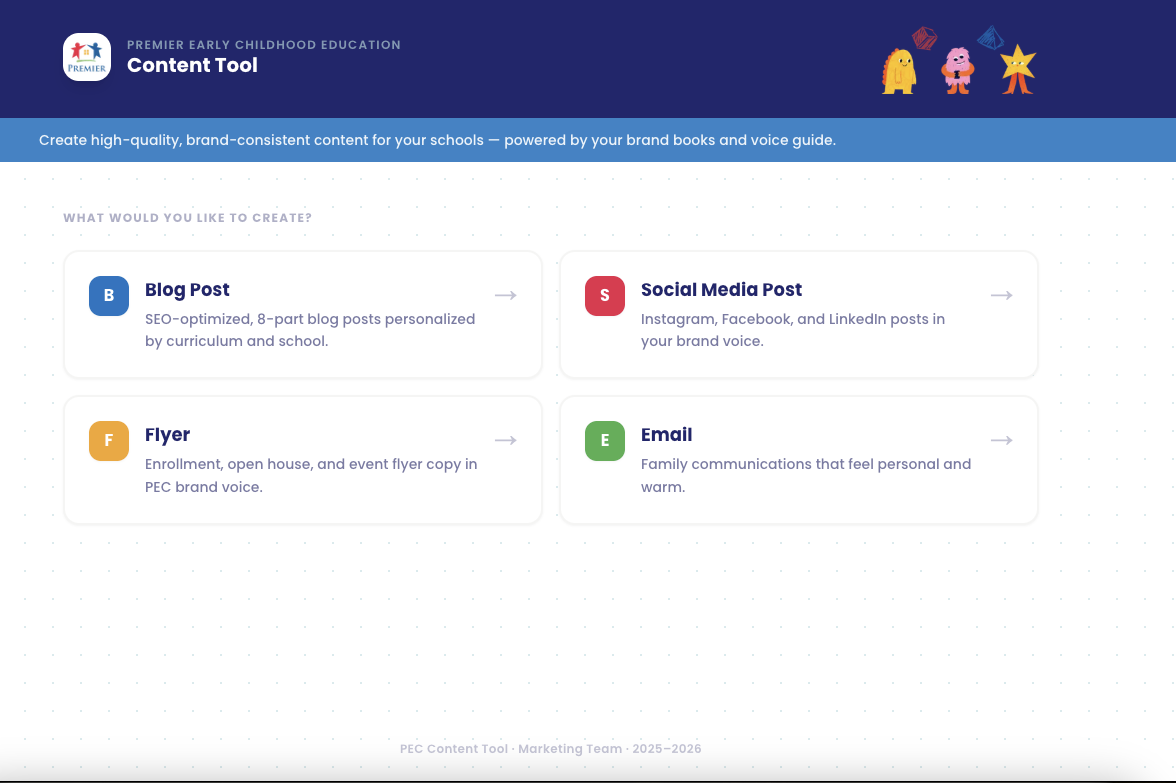
I built a custom AI-powered tool using Claude Code and Lovable — a month-long solo build involving significant iteration on logic, structure, and the knowledge base behind it.
- 01
Input
School location + curriculum type
- 02
Knowledge base
Personas, 100+ keywords, GEO structure, voice guidelines
- 03
Tool
Claude Code + Lovable app
- 04
Output
Blog draft + SEO metadata + social post + iteration box
Inside the knowledge base
Roughly 10 documents per curriculum, including:
- A parent persona for each of the four curriculum types, representing the audience each school speaks to
- A curated keyword database of 100+ terms per curriculum, pulled from Semrush and Google Search Console
- AIO/GEO-optimized structural templates: introduction, FAQ block in People Also Ask format, internal resource links, and authoritative external citations only
- Voice and tone guidelines written to sound like a knowledgeable educator speaking directly to parents
What made it different from generic AI content
The tool doesn't just generate content — it generates curriculum-specific, audience-aware, search-optimized content that reflects how each school actually talks to its community. Because the personas, keywords, structure, and voice guidelines are baked in, the output is consistent and usable without extensive editing. It also only cites authorized, credible sources — a deliberate guardrail built in to protect brand integrity and content accuracy.
“The knowledge base does the heavy lifting.”
Results
- 39,184 social impressions from content generated through the system
- 73 leads in active pipeline attributed to content-driven organic visibility
- All 45 schools now receiving curriculum-specific, SEO-optimized content — previously impossible at this scale with a team of three
These numbers reflect performance trends across the broader content program and should not be read as proof that a single channel caused enrollment outcomes.
What this case shows
This project shows how I approach operational problems strategically: not by adding resources, but by designing systems. Building this tool required content strategy (what makes each curriculum distinct), SEO knowledge (how to structure for search and AI search), technical initiative (building with Claude Code and Lovable), and project management (a month of solo iteration to get the logic right). The result is infrastructure that scales.